KCR 2026 Invited Talk · Aneurysm Detection with AI
The opening talk of KCR 2026 Special Focus Session 17 (Neurointervention): twenty minutes on where intracranial aneurysm AI stands and where it is going, covering the evidence at seven steps of the care pathway and six checks before clinical use.
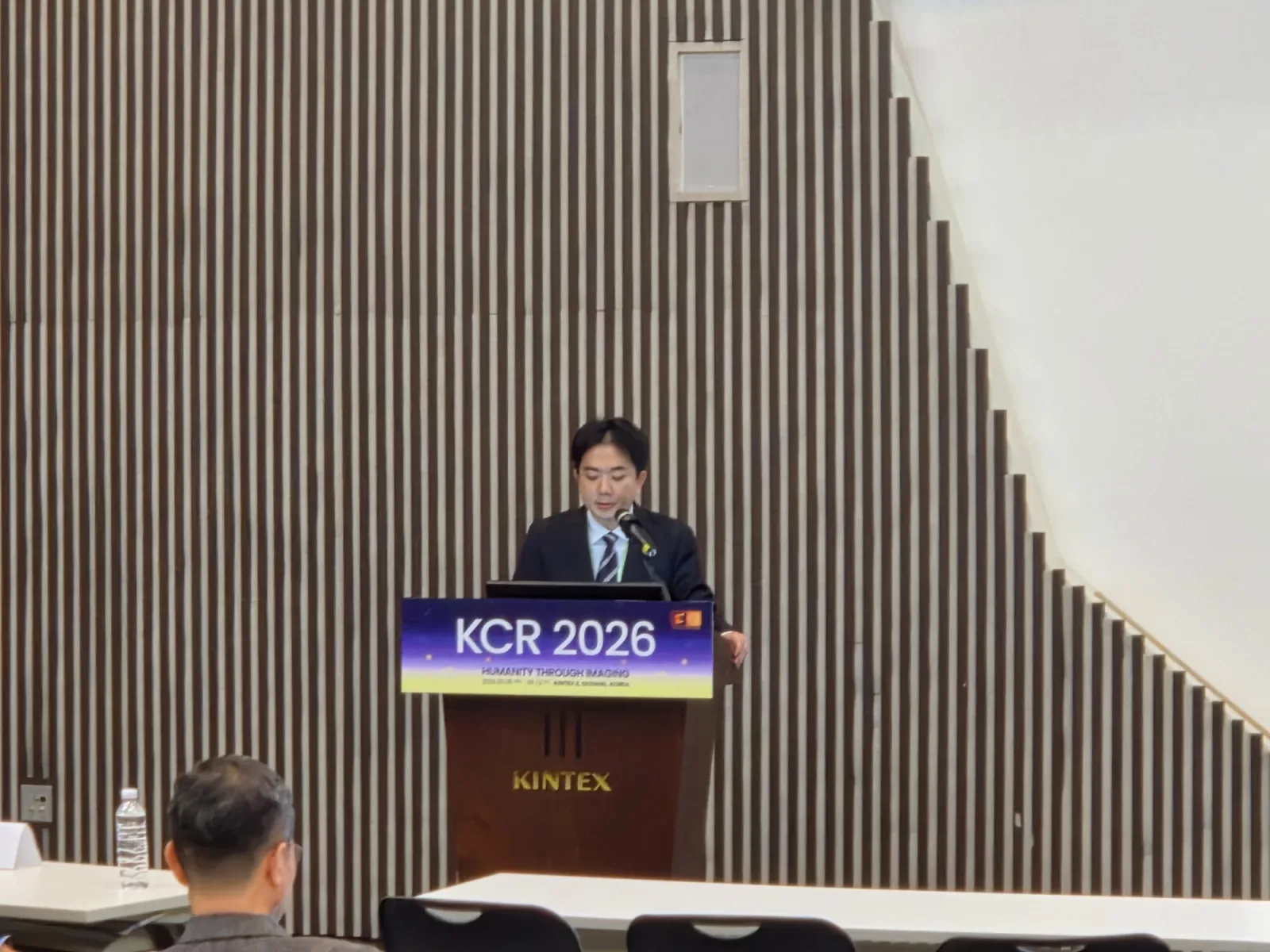
Overview
- Date: Friday, 11 September 2026, 16:30–16:50 (20 minutes, first talk of the 16:30–17:50 session)
- Venue: Room 403, 4th floor, KINTEX Exhibition Center 2
- Session: KCR 2026 Special Focus Session 17 · Neurointervention, "Intracranial Aneurysm: From Detection to Treatment and Follow-Up"
- Talk title: Aneurysm Detection with AI: Current Status and Future Directions
- Format: Invited lecture
Seven steps of the care pathway
I opened by splitting aneurysm care into seven steps (Detect, Measure, Risk, Watch, Plan, Verify, Report) and argued that each step needs a different kind of evidence. Our review of 136 AI studies across the aneurysm pathway from 2018 to 2026 found the number of studies rising quickly, while only 30.1% (41/136) were tested on external data.
Detect is the step where clinical products already exist. I covered an early second-reader study, a reader study in which AI assistance raised reader sensitivity on CTA (Park 2019, JAMA Netw Open), and uses in subarachnoid haemorrhage imaging.
The other six steps have less mature evidence. I went through segmentation-based size measurement, rupture-risk prediction, follow-up decisions, flow simulation for treatment planning, treatment-outcome prediction, and language models used for report quality checks.
Using it well
The second part was about judging a study and choosing a clinical tool. I proposed six checks before clinical use: separate test data, calibration, false marks per scan, sensitivity for small lesions, testing in the real workflow, and evaluating the reader together with the AI. In the flow-diverter systematic review I also presented, full reporting of the checklist items was 26.3%.
Two studies supported the point. In one, the same product showed different sensitivity and false marks per scan in its development report and in an independent clinical cohort (Ito 2026). In the other, false AI marks changed normal calls, most clearly among trainees (Kim 2025).
Closing
The last slide asked for four things: test on local data, evaluate reader and AI together, monitor in routine use, and recheck when the tool or the setting changes. Thanks to the congress for inviting me to open the session.