Pusan National University Hospital DART · Five-Track Hands-on for Surgical Specialties
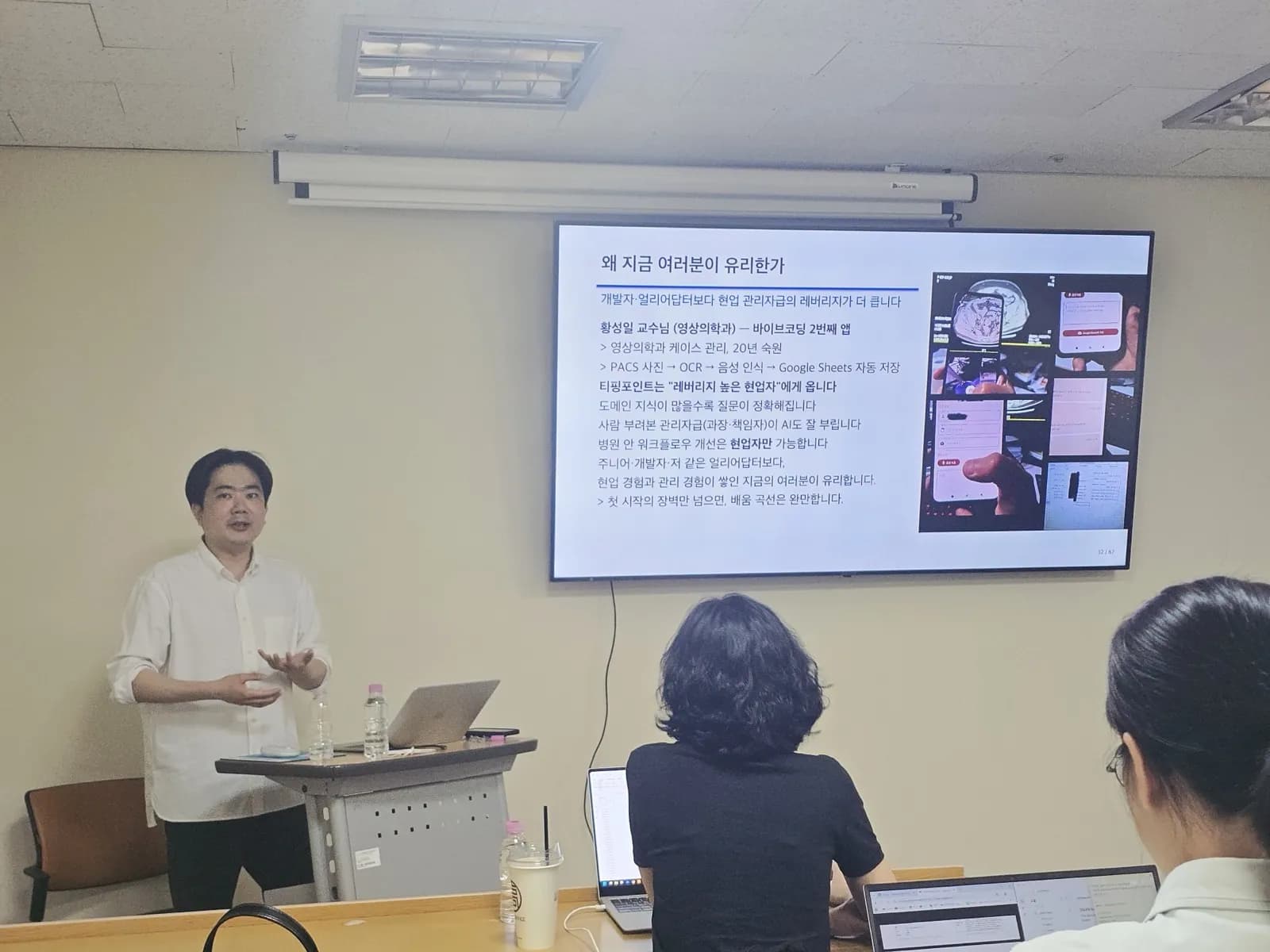
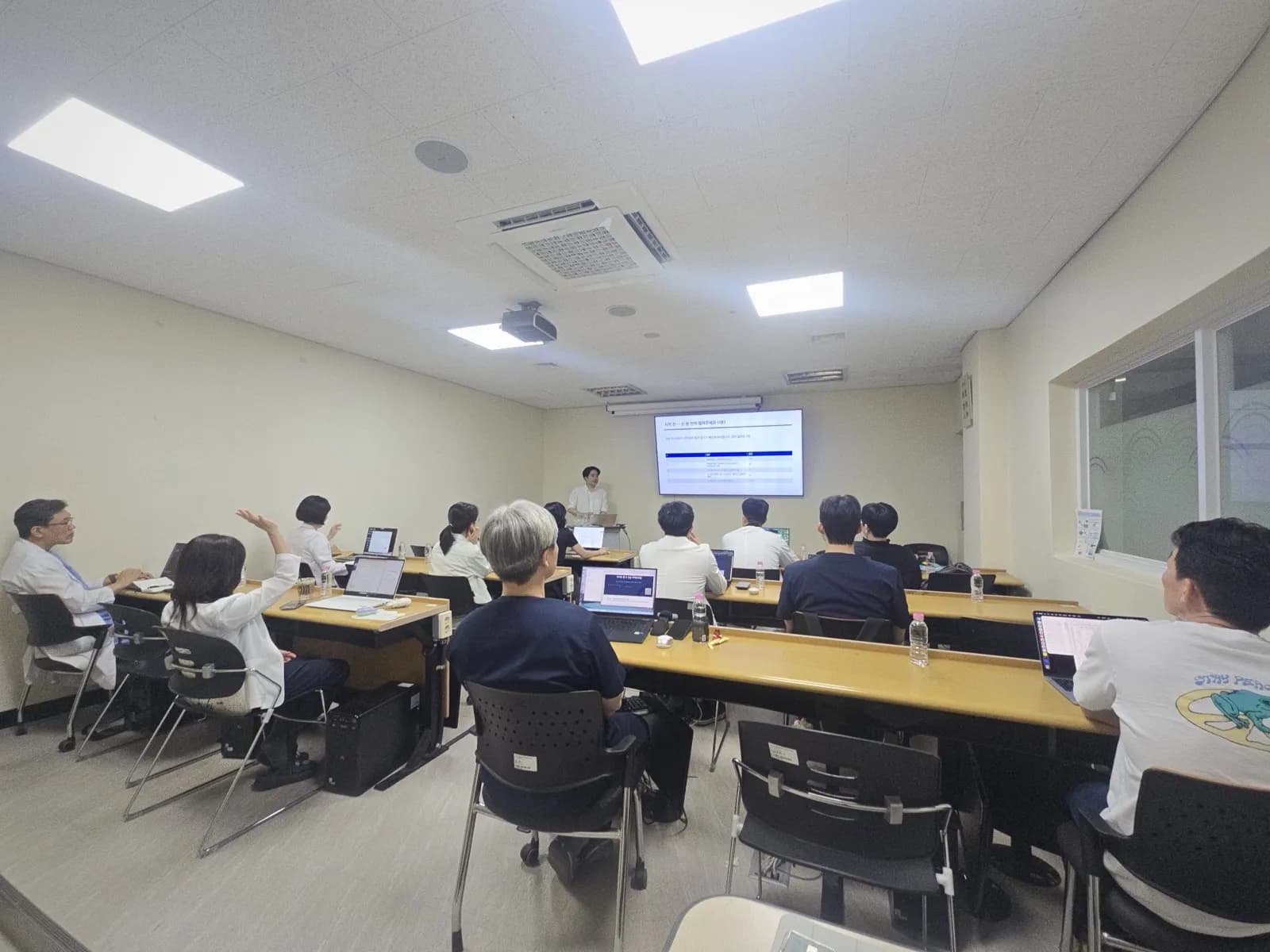
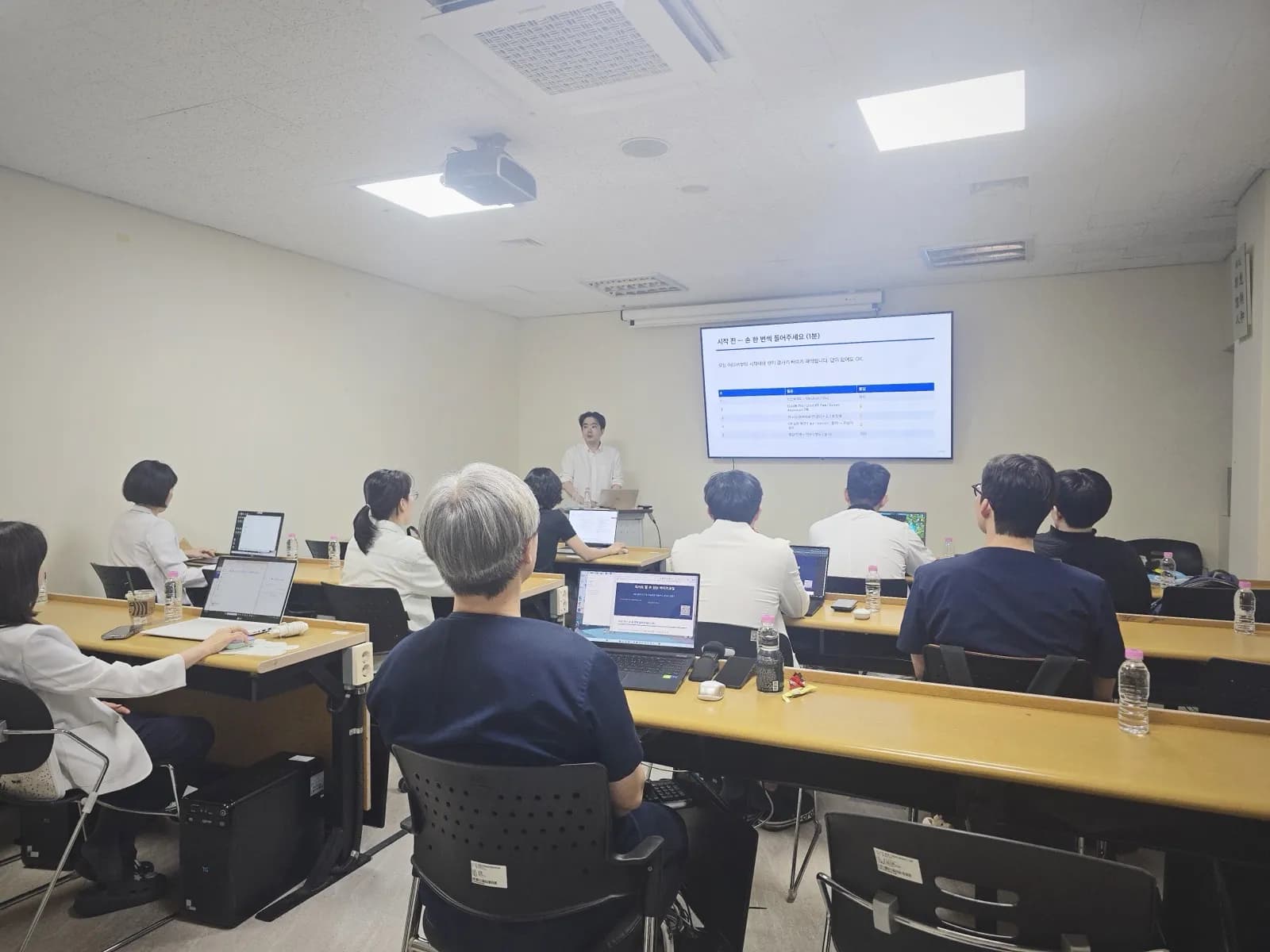
Seventeen attendees — surgeons, urologists, orthopaedic, thoracic and oral-maxillofacial faculty alongside internal medicine. Five tracks branching from a single demo, with each participant working toward their own first concrete result in two and a half hours.
Overview
- Date: Thursday, 15 May 2026, 15:00 – 17:30 (2.5 hours)
- Venue: Convergence Institute, PNU Yangsan campus
- Attendees: 17 (10 faculty, 1 clinical fellow, 6 residents)
- Format: Hands-on with five-track branching (Claude Desktop + Claude Code, personal laptops)
Why this workshop
This session happened on the invitation of Professor Changin Choi (PNU Surgery). The pre-survey made it clear that surgical specialties' needs split into three sharp lines — "statistics is always where I get stuck," "I want to automate the data cleanup and accumulation," and "I want to make patient-education materials." A simple research vs build two-track split wouldn't have captured that.
So the structure was rebuilt around five tracks — (A) entry-level data analysis, (B) hypothesis and abstract scaffolding, (C) complex analysis design (surgical cohorts), (D) clinical tools and automation, (E) comparison and integration with other tools (ChatGPT, Gemini). The main demo stayed on the health-checkup data flow that any track could adapt, while each track had a distinct entry first line.
What participants built
The moments that drew the strongest reactions:
- First analysis flow on a surgical cohort. Faculty who had been stuck on statistics for months pushed through with a single sentence defining their data and watched the next line follow.
- A one-screen patient-education tool. Something that can be displayed directly in the outpatient clinic. The smallest unit of a tool that shaves five minutes off a consult.
- Automated data-cleanup workflow. Weekly manual cleanup transformed into automated domain-specific classification.
- Image analysis + manuscript entry track — even participants new to image analysis went through the how to enter hands-on path.
The most striking pattern was the density of questions from a surgical audience. Surgeons evaluate tools against "I have to use this in tomorrow's clinic" — they reverse-engineer the demo on the spot to fit their consultation flow.
What I learned
The five-track structure fits the multi-layered needs of a surgical audience. The structure that emerged at the hospital-wide workshop (12 May) ported cleanly to an external audience. When one room contains people who urgently need a clinical tool, people who urgently need a manuscript, and people who urgently need statistics, splitting them and letting each side run their own pace is the structure that holds.
OS, AI experience, and tool preferences all varied. Windows 13 · Mac 4 (Apple Silicon 2 · Intel 1 · both 1); AI experience: docs/search 11, coding assist 5, almost none 1. Without track E (comparison with other tools) pre-defined, a few participants could have drifted out of their own pace.
A pre-arrival 30-minute setup support determines that one person's experience. A participant who indicated "can arrive at 14:30" received 1:1 install support on arrival, which freed the entire main session for their own work. This early-arrival + individual support pattern became the default for every later workshop.
What comes next
Sincere thanks to Professor Changin Choi for the invitation and for the generous mentorship — over meals before and after the session — on surgical clinical practice, research, and organisational leadership. The "I have to use this tomorrow" pressure from a surgical audience is also the fastest stress test a new tool can get.
Voices from the room
“Statistics had always been the wall. Today, a single sentence defining my data was enough for the analysis to follow.”
“Once I made a one-screen patient-education tool, I could see exactly how to drop it into my outpatient clinic.”
“It was my first time on a Mac. Five minutes of help from the person next to me and I was self-sufficient.”