Kosin University Gospel Hospital · Plastic-Surgery-led Clinical Tool Build
Thirteen attendees, with five plastic-surgery faculty at the core alongside a medical student and developers. The main demo was built on the host professor's own 150-patient breast-reconstruction cohort, fusing research and clinical-tool building into one flow over three hours.
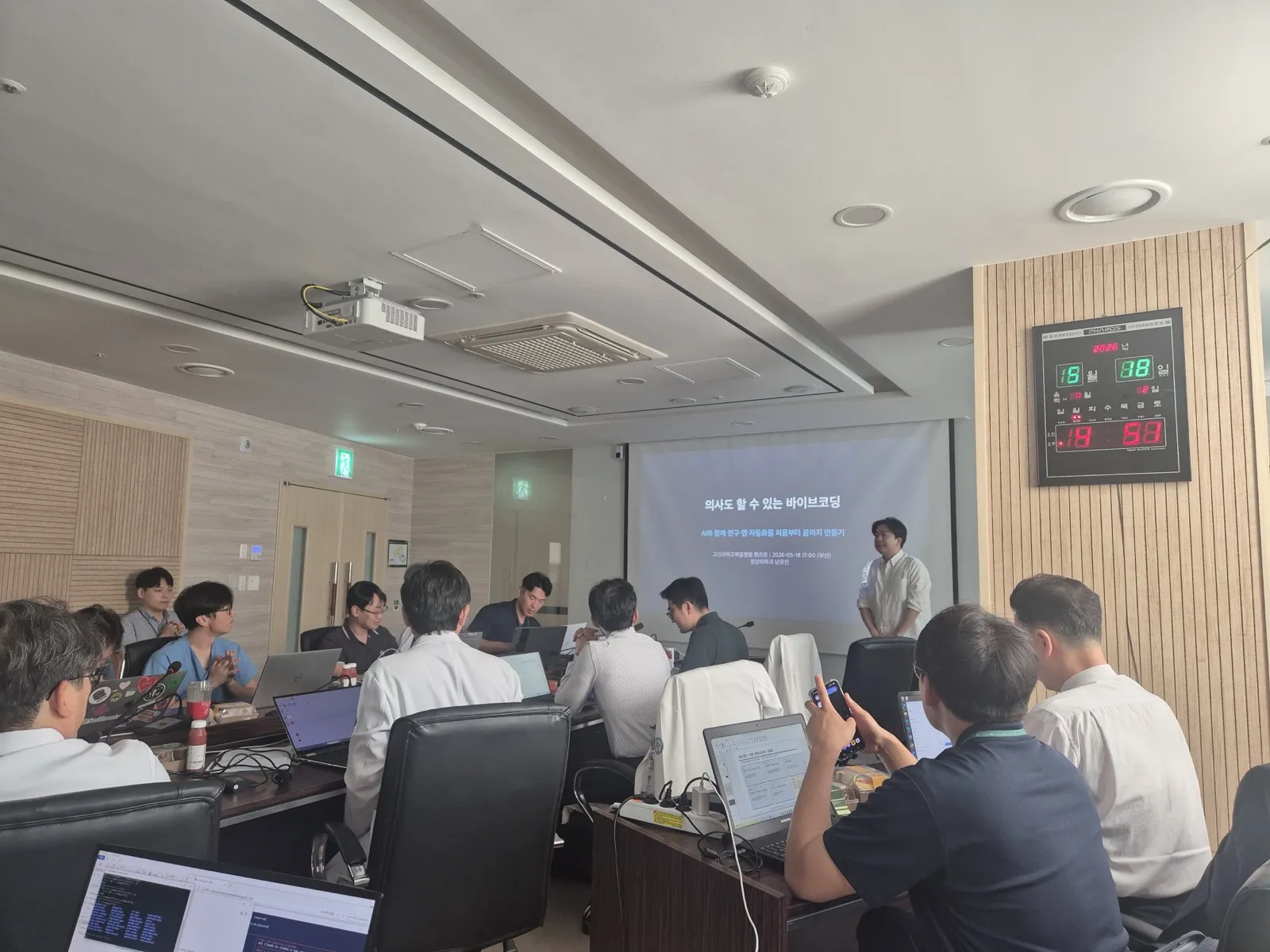
Overview
- Date: Monday, 18 May 2026, 17:00 – 20:00 (3 hours)
- Venue: Conference room, Kosin University Gospel Hospital
- Attendees: 13 (five plastic-surgery faculty as the core, plus obstetrics, urology, neurosurgery, a medical student, developers, and external relations)
- Format: Hands-on with five-track branching, main demo built on host cohort data
Why this workshop
This session was hosted by Professor Yoonsoo Kim (Plastic Surgery). The most striking thing in the pre-survey was the host's clear vision: "I have data on 150 nipple-sparing mastectomy (NSM) patients, and I want to connect that to a next-patient implant recommendation logic."
So the main demo was built directly on that data. De-identification (/deidentify) → EDA → first Table 1 → first HTML screen of next-patient recommendation, in one continuous flow. The point was to show — live — that research (data analysis) and build (clinical tools) are not separate tracks but one continuous flow on the same data.
The audience composition was also diverse — 5 plastic-surgery faculty (the core), 2 each from obstetrics and urology, 1 neurosurgery, 1 second-year medical student, 2 developers, 1 external-relations staff. So the room split into five tracks — (A) clinical tool build, (B) data analysis → recommendation/app, (C) learning/education automation (medical student), (D) research abstracts/hypotheses, (E) other-tool comparison and developer applications.
What participants built
The strongest moments:
- The host's 150-patient NSM data as main demo. De-identification → first Table 1 → distribution figure → first HTML of a next-patient implant recommendation — one continuous flow. The audience saw research turn directly into a clinical-decision tool, live.
- Patient-photo classification and lesion tracking workflows. Automating the classification work that plastic surgeons repeat every day. Multiple participants said they would apply it in the next outpatient week.
- Surgical-record Android app idea. One participant launched the first screen of a mobile surgical-record tool on the spot.
- Medical student track (learning automation). A second-year medical student walked away with a flow for organising their notes, Anki, and lecture materials. Confirmation that the same tools work for the learning stage of the audience too.
- Two developers in the room. The guidance for them shifted from slash commands toward clinical application patterns. Both ended up acting as informal helpers for the people sitting next to them.
The most striking pattern was the scale of the problem senior faculty define. Where residents and clinical fellows focus on a tool that shaves an hour off tomorrow's clinic, senior faculty draw the larger picture: from a 150-patient cohort to the next patient's decision. The session was another confirmation that domain knowledge, clinical experience, and planning ability become more decisive — not less — in the AI era.
What I learned
Using host data for the main demo produces a real demo. Generic public datasets are fine, but when the main demo is the question the host is actually trying to answer in their own patients, that demo becomes a research result and a clinical-decision tool at the same time, in the room. It takes more pre-coordination, but the difference in impact is significant.
Operating a mixed-role room. When plastic surgeons, a medical student, and developers share a room, tone, vocabulary, and pace all differ. Splitting into five tracks lets each person follow their own line, and the final share-out turns that diversity into different application examples for everyone. The medical student sees the senior's big picture; the senior sees, in the medical student's learning automation, a pattern they can apply to teaching juniors.
What comes next
Sincere thanks to Professor Yoonsoo Kim for making the session happen, for offering his own data as the main demo, and for generously sharing — over the meals before and after — the experience of clinical practice, research, and patient decision-making in plastic surgery. The host-cohort → clinical-tool connection pattern that came together here is a design we can replicate in collaboration with senior faculty across other specialties.
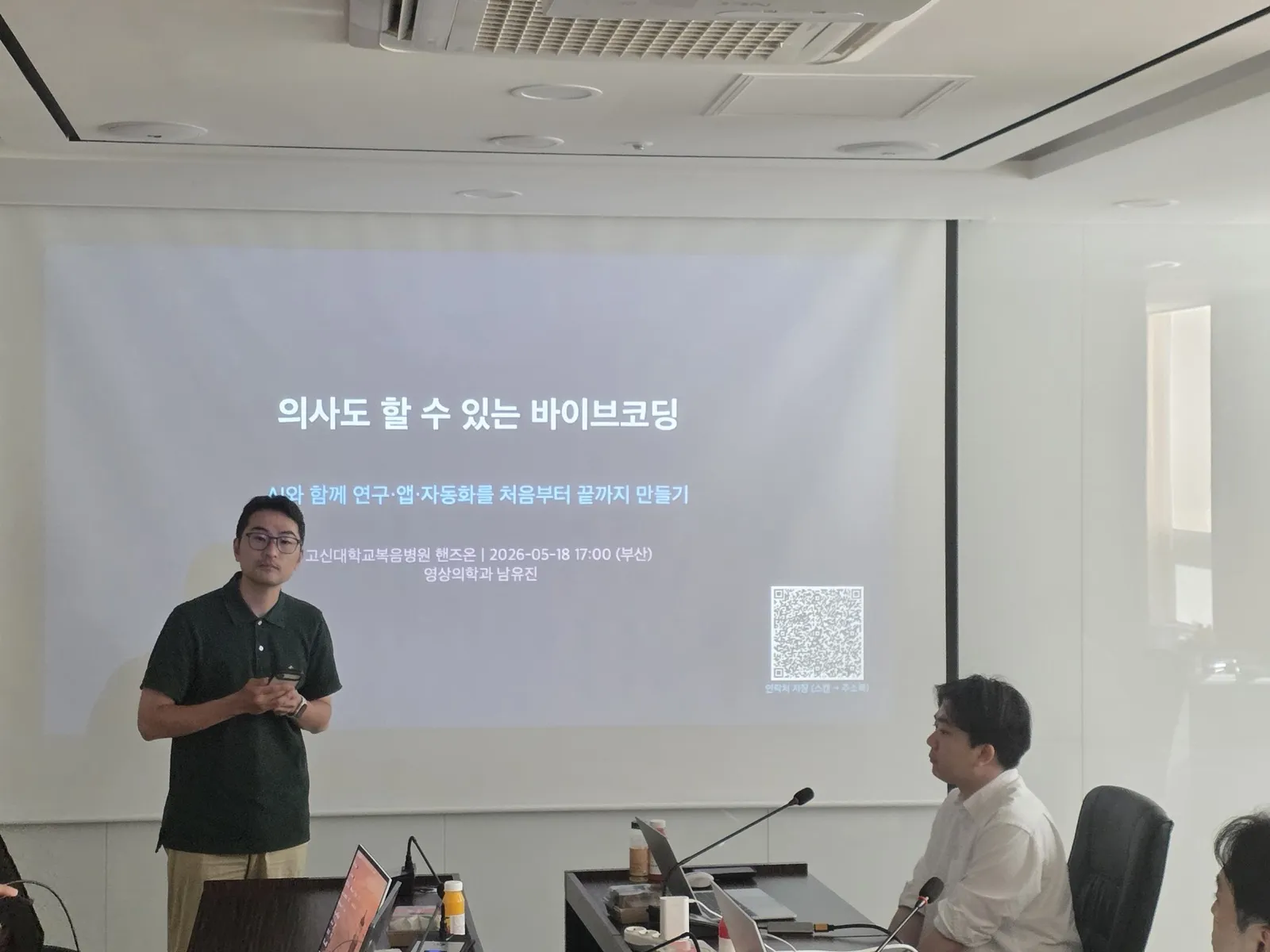
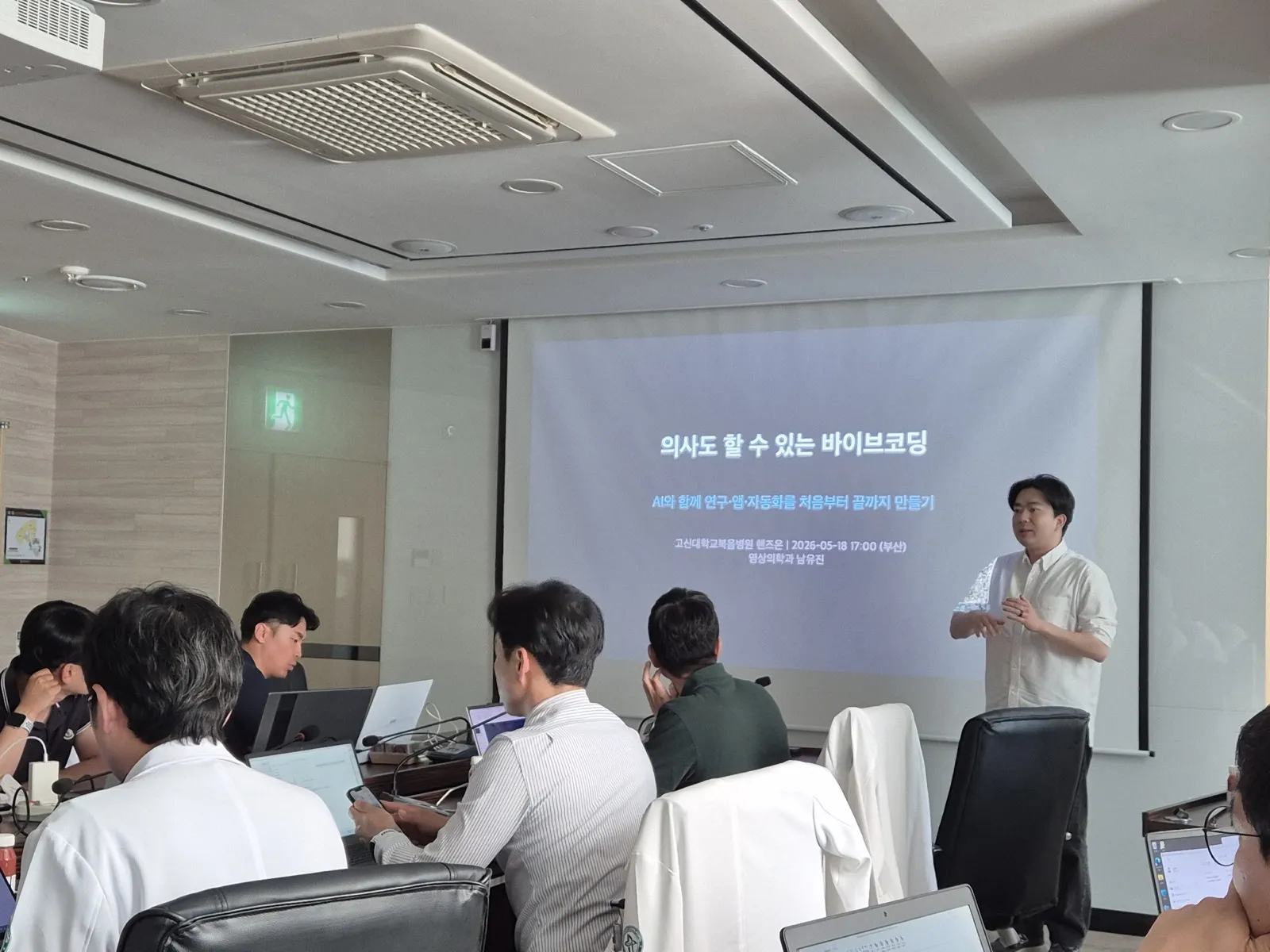
Voices from the room
“Cleaning up my 150-patient data in one flow and sketching the next-patient recommendation logic on top of it — that's a picture I can carry straight into clinic.”
“Surgical records, patient-photo classification — for the first time I saw the picture of how to automate things I do every day.”
“Even with a development background, clinical application was always the hard part. This session made the *domain × AI* combination concrete.”