AI Vibe Coding Workshop Series — Busan · Ulsan · Gyeongnam, Six Sessions, ~150 People
A reflection on six AI vibe coding workshops across Samsung Changwon, Kyungnam University, Pusan National University, and Kosin University Gospel Hospital. Two-track hypothesis validated, pre-install guides matured, the senior/junior perspective gap, and the conclusion that domain, experience, and leadership are what compound.
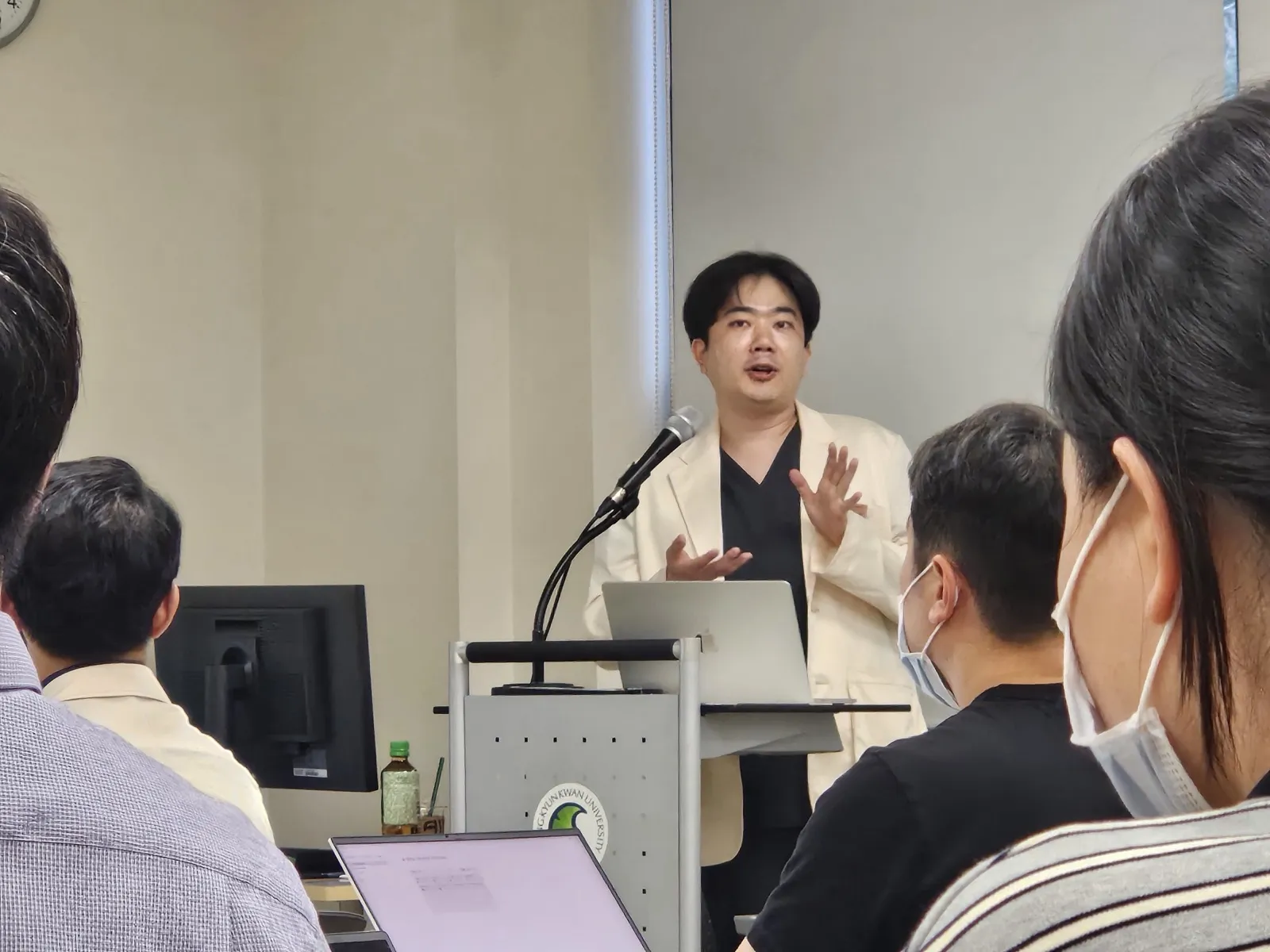
Series overview
This wraps up the AI vibe coding workshop series I ran across the Busan, Ulsan, and Gyeongnam region. Six sessions in total, about 150 attendees, across Samsung Changwon, Kyungnam University, Pusan National University, and Kosin University Gospel Hospital. Being a resident invited into rooms where senior faculty also attended was, by itself, a privilege. The series was another reminder that when a new technology emerges, unexpected opportunities open up — even for people early in their careers.
Two tracks
The workshops were structured around two tracks — a research track and a build track.
Each session was preceded by a Google Form asking "what do you actually want to build?", and the materials were authored from those responses. After the early sessions burned too much time on installation, a dedicated pre-install guide was created and distributed in advance. A small detail, but it made an outsized difference to participant satisfaction.
The framing was never "AI is amazing." It was always how do you connect this to your actual work. The concept of vibe coding, current trends, the skill-and-memory harness, then the practical layer — Claude Code project setup, model selection, plan mode, context management — got as much of the available time as possible.
The first hurdle
What was most interesting was the consistent pattern at the start. Participants who weren't used to computers asked questions very tentatively — "can I even ask this kind of thing…" But once that first hurdle was over, they built their own products at a speed that was hard to keep up with.
The other lesson, reinforced session after session: this is not a field where one person transmitting their experience completes the picture. It is a field that develops collectively, through the trial-and-error and tip-sharing of the participants themselves. So every session ended with a sharing time — what each person built and what they got stuck on. One person shared a statistical-analysis flow; another, a presentation-deck workflow; another, an app-build journey. Those final hours were as much learning for me as for the attendees.
The senior–junior perspective gap
A few patterns stood out across the series.
Residents most often used the tools to make their immediate work faster. Reading-report style conversions matched to a senior's preferences, presentation deck generation, abstract drafting — work for the next week.
Senior faculty were defining much larger problems. Research statistical analysis, meta-analysis pipelines, Android apps for surgical records, implant-tracking apps for breast reconstruction — clinical-problem-solving ideas at a scale that doesn't show up in a resident's day.
Watching that contrast, the closing message at each session became consistent:
"As AI begins to assist us, what becomes more — not less — decisive is domain knowledge, life experience, planning ability, and the leadership to move people. This can be a game that favours seniors. Juniors may see fewer of the natural opportunities that the old apprenticeship structure used to hand them. But when those opportunities do come, absorbing how seniors think and how they run organisations — gratefully, from the seat next to them — can open even bigger ones."
What I took away most — people and experience
The biggest thing I took away from this series was people and experience. Until now my own experience had been largely confined to medical imaging AI. Meeting faculty across so many specialties exposed me to needs and research currents in clinical practice I had no idea existed.
The advice over meals, the stories of pushing innovation inside an organisation, the questions of how to actually persuade people — all of it became a real asset. Above all, the energy of people working to create change inside their own institutions left the strongest impression.
What I said in every session
"I am not an expert. I am someone who hit the trial-and-error a few months before you did, compressed into a short delivery. Within about a week of trying it yourselves, you'll be at least where I am. What I hope for is that the know-how that comes out of all this gets shared back. That flow — over time — is what will bring real change to the medical community of this region."
What comes next
A new chapter begins in June, so I'll step back and focus more quietly on my own work. The workshops were small, but I hope they were the starting point of a change for at least someone.
Deep thanks again to the host professors — at Kyungnam University Hospital Radiology, PNU Surgery, and Kosin University Plastic Surgery — for inviting me, introducing me generously, and taking such careful care of the practical details from honoraria to meals.
Voices from the room
“Let's go to the research support office tomorrow and request the data.”
“I had never coded once in my life, and two hours later I had the first screen.”
“In the AI era, the game can actually favour the senior.”